AI visibility ·
How estate agencies get recommended by AI, and why it suddenly matters more
Google is testing AI Overviews that expand automatically and push organic results further down, while agents pay to seed Reddit with their own praise. What both shifts mean for agencies, and how to earn AI recommendations properly: structured answers, original market data and genuine third-party coverage.
In the last week of August, two things happened that change the maths of property marketing. Google confirmed that AI Overviews can now expand automatically, filling the screen with a finished answer before anyone has clicked a thing. And HousingWire put a name to the industry growing up around the other side of the same shift: agents paying to have their names dropped into Reddit threads by people posing as happy clients, in the hope that ChatGPT picks it up and repeats it.
Each is a story about one platform. Together they describe one change: the recommendation, the moment an assistant names an agency to a buyer, is becoming the most valuable placement in property marketing, and both the honest work and the spam that chase it are accelerating at the same time.
This piece covers what changed, what the click data now shows, why the seeding shortcut fails on its own terms, and what actually earns a place in the answers.
The answer now arrives already open
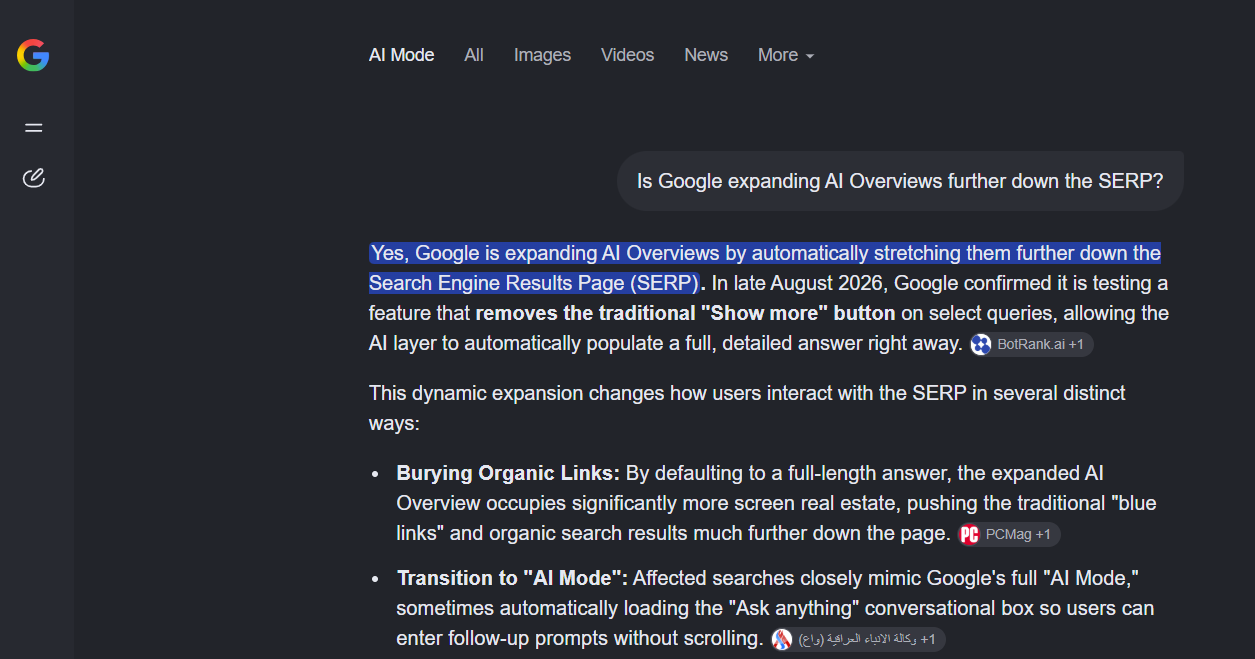
An AI Overview used to behave like a preview: a few lines, a Show more button, then the familiar links. On 28 August, after search marketers spotted full-length answers appearing on their own, Google confirmed to Search Engine Land that AI Overviews "may dynamically expand" on queries where its systems decide a fuller answer is more useful. No button, no click: the complete answer unfolds by itself, sometimes with an AI Mode style "Ask anything" box underneath, and the organic results move further down to make room.
The results are still there. They are just further away, behind an answer that no longer waits to be asked for. Google frames the change as helpfulness, and for the searcher it often is. For anyone whose business depends on the links underneath, the reading 9to5Google gave it is the honest one: the AI layer gets bigger, and everything below it gets buried.
The click data was already stark before this change. Pew Research Center measured real browsing behaviour across 68,879 searches: when a search produced an AI summary, people clicked a traditional result on 8% of visits, against 15% without one, and clicked a source cited inside the summary just 1% of the time. Ahrefs re-ran its clickthrough study this February across 300,000 keywords: the presence of an AI Overview now correlates with a 58% lower clickthrough rate for the top-ranking page, up from 34.5% when it first measured a year earlier.
Two caveats before you carry those numbers over to your own site. They measure search at large, not property, and property is unusually click-hungry: nobody buys a house inside an AI answer, and a buyer who wants to walk through a villa, check what is left in a development or reach an agent has to arrive somewhere to do it. Expect your own clickthrough to hold up better than the averages. Treat the headline percentages as direction, not as your number.
What does not soften is the second half of it. An assistant answering "which agency should I use in Marbella" typically names several, and the clicks that follow go to the ones it named. So the contest moves upstream. It is no longer about climbing from third to first on a page of ten blue links; it is about being in the answer at all, and about which of the three or four named agencies you are. That is the whole shift from SEO to AI visibility, and it is why the number worth tracking is no longer where you rank, but how often you are named and in whose company.
Buyers moved before the industry did
None of this would matter if buyers were not already living inside these tools. They are. BrightLocal's consumer survey this March found 45% of people now use AI when looking for local business recommendations, up from 6% a year earlier. Google says AI Mode passed a billion monthly users within a year of its global rollout. Adobe measured AI referral traffic to US retail sites up 62% year on year in July, converting 60% better than other visits. And in Veterans United's June survey of prospective home buyers, 53% said they would be comfortable buying without direct human involvement.
Property-specific data is younger and mostly vendor-collected, so handle it with tongs, but the shape is consistent. An industry study reported by HousingWire in May found 8.4% of US agents appearing in AI answers at all, with the top 1% collecting nearly half of all citations. That matches what we see running audits on the Costa del Sol: most answers name somebody, the same few names keep coming back, and everybody else is invisible.
Our audits add a wrinkle that matters enormously in an international market: the shortlist changes with the language of the question. Ask which agency to use in Marbella in English, then in Spanish, then in Dutch, and you can get three different sets of names, because the assistants are reading three different bodies of evidence. An agency can be perfectly visible to its British buyers and absent for its Dutch and Scandinavian ones without anyone in the office ever noticing.
- use AI for local business recommendations
- 45%BrightLocal survey of 1,002 US consumers, March 2026. A year earlier: 6%.
- lower clickthrough for the top result under an AI Overview
- 58%Ahrefs, 300,000 keywords, February 2026. Its first study, a year earlier, measured 34.5%.
- of AI-summary visits click a source the summary cites
- 1%Pew Research Center, 68,879 real searches by 900 US adults, March 2025.
The seeding industry has arrived, and it is a trap
Now the other August story. On the 31st, HousingWire published a piece built around the question every agency owner will hear from a vendor this year: if ChatGPT picks three agents, how do you get on the list? Part of its answer describes what some agents have been quietly buying: people paid to drop the agency's name into Reddit threads while posing as satisfied clients, on the theory that the assistants read Reddit, so being praised there gets you recommended.
The theory was not stupid, it was just late. Reddit licensed its content to the model companies, and in early August 2025 Semrush's study of 230,000 prompts found Reddit surfacing in close to 60% of ChatGPT responses. If one forum carries that much weight, manufacturing a presence on it looks like arbitrage. Three things have happened since.
The surface collapsed, and then collapsed again. The same Semrush data tracked Reddit falling from that 60% to around 10% of ChatGPT responses within six weeks, by mid-September 2025, with editorial and news domains gaining what Reddit lost. Then it went a second time, last month: Promptwatch measured Reddit's share of ChatGPT citations dropping from 3.8% in the opening days of August 2026 to 0.5% by the middle of the month. The two studies count different things, responses touched against citations given, so the percentages are not one continuous series, but the direction is not in doubt. Paying to be seeded into Reddit is buying shelf space in a shop the customers are leaving.
The platform is hunting it. Reddit now runs its own AI-powered enforcement against precisely this behaviour, and by its own account catches around 25,000 spam posts and comments a day and revoked some two million inauthentic votes in a recent three-month stretch. Its message to brands gaming AI citations, delivered to Axios in August, was that they "risk frustrating your consumers here". Seeded threads do not quietly compound in the training data. They get removed, along with the accounts that posted them.
The law got there first. The US FTC's rule on consumer reviews and testimonials has been in force since October 2024. It prohibits fake or AI-generated reviews, undisclosed insider endorsements and purchased fake social signals, at up to $53,088 per violation, and the first warning letters went out in December. A Reddit post written as a fictional satisfied client is not a grey area under that rule, European consumer law treats posing as a consumer the same way, and NAR's Code of Ethics adds its own requirement to present a true picture in advertising.
Underneath all three sits the older problem. Your clients are making the largest purchase of their lives on trust. One exposed thread, one screenshot of an invoice for Reddit mentions, and a decade of earned reputation is gone in an afternoon. The fine is survivable. The search result pairing your brand name with the word fake is not.
What actually earns the recommendation
The useful truth inside all of this is that the assistants are not picking names out of the air. They corroborate. Trace where answers come from, as we do in every audit, and the same two kinds of evidence keep deciding who gets named.
Your own site, structured to answer. BrightLocal's testing found business websites the most used source in ChatGPT's local recommendations, ahead of any directory or portal. What gets read is the page that directly answers a buyer's real question, in the buyer's words: which areas of Marbella suit a family with school-age children, what the full costs come to on an €800,000 purchase, which villas under €5m sit within walking distance of a beach. One question per page, a straight answer in the first paragraph, an FAQ that matches its markup, and the technical basics that let a crawler through the door.
Original market data nobody else has. An agency sits on evidence no journalist, no rival and no model can get anywhere else: what actually sold, how asking prices moved against closing prices, how long homes really sit on the market, which nationalities are buying on which streets. Publish it under your own name on a fixed rhythm and you become the citable source for your market. Everything else flows downhill from that position, and nobody can seed their way into it.
Third-party proof that is true. The external mentions that survive scrutiny all have a person attached: coverage in the local and national press, the Dutch and Nordic magazines your buyers actually read, a partner naming you in their own guide, a transaction written up with real numbers, reviews from verifiable clients on the platforms the assistants read, a YouTube tour with a proper description and transcript, because models read the text around a video rather than the video. All of it slower than a seeded thread. Also the only category of mention that became more valuable this year, as the engines moved weight from forums to editorial sources.
Notice what everything on both lists has in common: it is true, it is attributable, and it would still be worth having if no AI ever read it. That is the whole test. The engines are drawing the line between visibility work and spam in the same place the regulator drew it: a mention that only works while nobody knows who wrote it is not an asset, it is a liability on a delay.
Questions to ask anyone selling you AI visibility
AI visibility is a real discipline now, with real budgets attached, and this site sells it, so read the following as the standard we expect to be held to as well:
- Where will every mention come from, and is each one disclosed and attributable? "We place content for you" needs a follow-up: published as whom?
- What survives if we part ways? Content on your domain, data under your name and earned press coverage keep working. Rented accounts and seeded threads do not.
- Are outcomes measured, not activity? Which questions were asked, in which languages, who was named, which sources were cited, week by week, misses included.
- Is anything guaranteed? Treat a guaranteed mention as disqualifying. Nobody controls what an assistant says, and a vendor promising the output is telling you something about their methods.
Where to start this month
- Measure before touching anything. Put twenty real buyer questions to ChatGPT, Google AI Mode, Gemini and Claude, in every language you sell in. Record who gets named and which sources get cited. That map is the work list.
- Fix readiness: crawler access, structured data, business facts consistent everywhere they appear, pages that render without JavaScript acrobatics. Unglamorous, checkable, foundational.
- Publish one real answer a week, in the language of the buyer who asks it, with your own data inside it.
- Earn corroboration deliberately: reviews on the platforms the assistants actually read, one piece of local or trade coverage a quarter, a transcript on every video.
Expect a quarter or two before it compounds, the same lag SEO always had. The difference is how empty the field still is. While most of the industry remains invisible in the answers, the cost of becoming the name your market's answers keep repeating is as low as it will ever be.
Frequently asked questions
- Does seeding Reddit threads improve ChatGPT recommendations?
- Not any more, and the risk is real. Reddit's share of ChatGPT answers collapsed between mid-2025 and August 2026, Reddit removes around 25,000 spam posts a day, and undisclosed paid endorsements break the FTC's consumer review rule and European consumer law. Genuine coverage and first-party content are what compound.
- What is AI visibility for an estate agency?
- The share of AI assistant answers that name or cite your agency when buyers ask about your market: which agency to use, which areas suit them, what buying costs. It is measured by putting real buyer questions to the assistants and recording who gets named and which sources get cited.
- How does an estate agency get recommended by ChatGPT?
- By being the best-evidenced answer: pages that directly answer buyer questions, original market data published under your name, consistent business facts, reviews on the platforms assistants read, and genuine press coverage. No outcome can be guaranteed, which is why the work is measured weekly.
- Do Google AI Overviews reduce clicks to websites?
- Yes, though the published figures measure search at large rather than property. Pew Research found people clicked a result on 8% of visits with an AI summary against 15% without, and Ahrefs measured a 58% lower clickthrough for the top result when an AI Overview is present. Property is more click-hungry than most categories, because nobody views a home or contacts an agent inside an answer, so expect your own drop to be smaller. What matters more is whether the answer names you at all.
Talk to us
Propelos builds AI-native websites and AI search for estate agencies, and our AI Visibility programmes run the work in this article as a weekly loop: measure what ChatGPT, Google AI Mode, Gemini and Claude say about you, then fix, publish and earn what the evidence points at. Everything published is disclosed, attributable and approved by you first, for all the reasons above.
The place to start is the free AI visibility audit: which questions your buyers ask, who the assistants currently name in your market, where you are cited and where you are absent.
Get in touch and tell us which market you sell into.